
This interview was published in the Anveshi Broadsheet on Contemporary Politics (No 13)
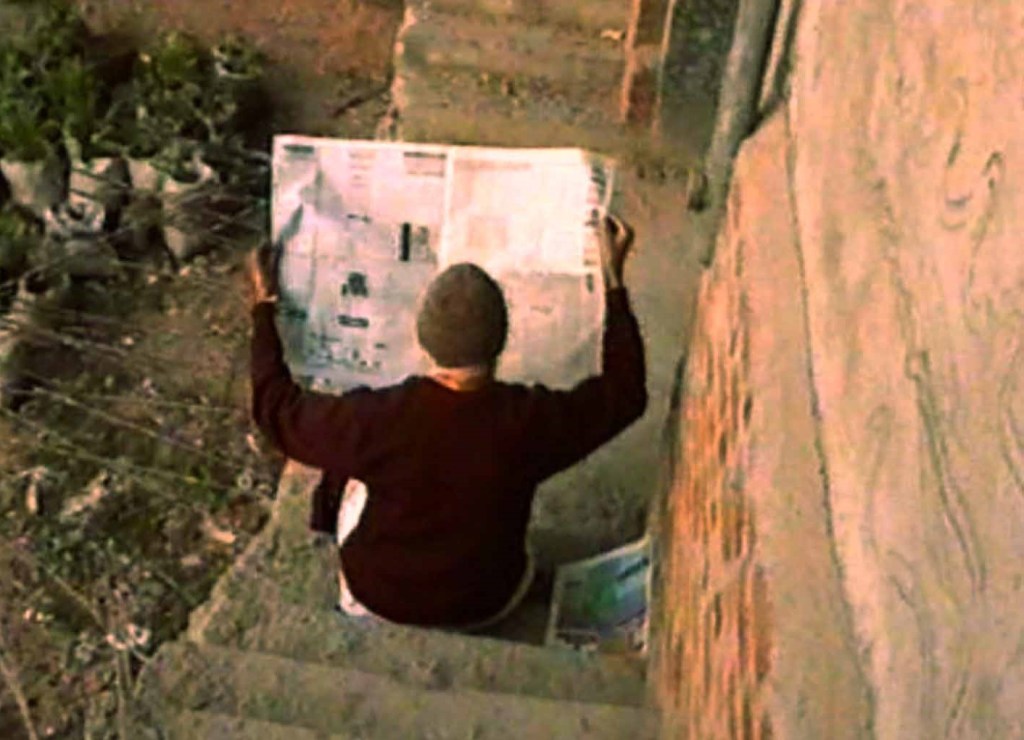
How did your film on the poet Kaloji come to be?
S. Amarnath: The filmmaker B. Narsing Rao approached me on behalf of the Kaloji Foundation, asking whether I would like to choose from some footage available to give to a television channel so that they will have something to air on the occasion of his birthday, the centenary celebrations of Kaloji’s birth. Since the foundation had been generating and archiving Kaloji material for about ten years, I think, and very little audio-visual content exists in the public domain where one can see Kaloji speak or talk or walk, the idea was to provide some footage so they could air it between programs, small thirty second or one minute bites. It was only after I saw the footage, in which Kaloji seemed so vulnerable, that I convinced Mr. Rao that I could make an interesting film that goes beyond celebrating a personality. I myself was surprised that the film came to an hour’s length.
What material were you given to work with?
S. Amarnath: I was given four pieces of material. One was an interview that Dr. Gujja Bhiksham, the writer, researcher and water conservationist, undertook with Kaloji in about 1993. In this interview, Bhiksham almost corners Kaloji into answering certain questions in such a way that Kaloji comes out as a human figure rather than a god, which such personalities can often be portrayed as. In a book published by the foundation, Bhiksham talks about why he did the interview the way he did – he’s talking to this independent, free soul and trying to demystify his personality rather than celebrate the artist, clapping and forgetting about him. I completely identified with his process and formed a strong relationship with the interview in making this film.
The second was an interview that the Kaloji Foundation asked the journalist Punna Krishnamurthy to undertake with Kaloji’s wife Rukmini Bai and his grandson Santosh in about 2003, after Kaloji had passed away, to get a sense of what his life was like. In the interview Krishnamurthy is driven by a brief to extract information about the life of Kaloji from Rukmini Bai which I was able to use to create a dialogue between the two interviews.
The third material I was given was from a film called Prajakavi Kaloji by Premraj, which is an informative or educative film that celebrates Kaloji’s life. It was most likely a Doordarshan film from the 1990’s, if I’m not mistaken. The fourth is a VHS tape shot at the book release function of Naa Godava, one of Kaloji’s most celebrated books, in which the former Prime Minister P.V. Narasimha Rao makes a speech in which he seems like a student or disciple in front of Kaloji. Since I primarily had interviews, I weave in these last two to get away from just talking heads, but also use them to build Kaloji up as a big personality or celebrated intellectual which deconstructs itself as the film proceeds.
How have you used the material you had access to?
S. Amarnath: The material I was given wasn’t flowery or beautifully shot. If I had done it, I wouldn’t have done it in that way, but the very fact that it’s not my material and I’m still using it I think there’s a lot of freedom in that, at least I enjoyed it. The whole process of capturing the way you want, conceiving, scripting, shooting and bringing it to the editing table, there’s a burden you carry from the process of capturing. Here, there was a lack of choice, but there’s a lot of freedom, an un-burdening of choice.
I was very much aware of the formats each was shot on, because a lot of things had changed between each material. Rukmini Bai’s interview was a little more polished, a little more clear because it was on Mini-DV, Bhiksham’s is on Hi-8 and Premraj’s film and the Narasimha Rao speech were both on VHS. So, there were three kinds of material that I was seeing lapses of time between. For me, I was trying to create conversations between people who existed in different times. One was Kaloji – twenty years back, Rukmini – almost ten years back, and the third is us – sitting now and also being involved in the conversation.
There’s a perception, when you look back at older formats, that they’re bad, out-dated in terms of quality and unusable as material, which is also why we are moving towards digitisation and all kinds of cleaning. I took the opposite approach in acknowledging the aesthetic possibilities in these apparently inferior formats. I try to contextualise Bhiksham’s interview as one that’s personal, intimate and non-professional, not shot by a television or cinema crew. It was just by a person. It could be by anybody, like you or me, who takes out their mobile phone and records a conversation with someone. I even establish Bhiksham, and later, while he is adjusting the camera, I retain a blue frame that appears. There was a huge fight around this blue frame with my editor and the producers. They thought I should get rid of it because it looks like a mistake. But I was clear what I was doing, I was keeping it in to give an idea of the scale of Bhiksham’s interview and also to pay a small tribute to an older format.
 amarnaths.com