
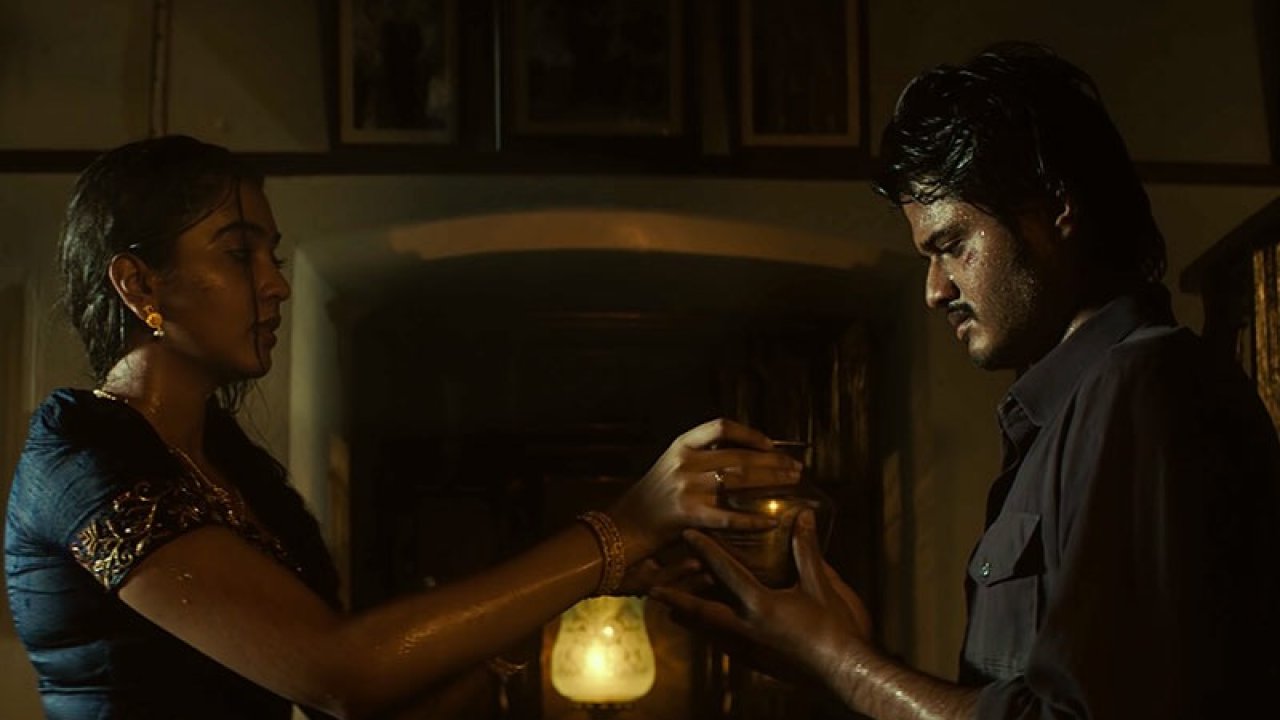
Yet another significant Friday for the emergence of Telangana idiom in popular Telugu cinema after Mallesham. This time it’s a classic Romeo-Juliet like love story. And what better place to locate it in, when set in the backdrop of Naxalite movement in Telangana, than the ‘dora gadi’ (feudal lord’s fortress), which historically has been the simmering war turf of socio-political conflict for the oppressed in Telangana.
Set in the late 80’s, during the downfall of the Naxalite movement in Telangana as the backdrop, Dorasaani is the story of Devaki and Raju who fall in love against all odds and struggle to keep it up. Devaki, also called as ‘chinna Dorasaani’ (princess), is the daughter of the ‘dora’ (feudal landlord) of the village and Raju is from a lower-caste family whose father paints walls.
Anand Devarakonda, with his innocent youngman gaze, sparkles in some of the scenes and delivers well for his debut. Vetaran theatre actor Vinay Verma gets the opening scene quite powerfully as the ‘dora’; with few inconsistencies, he retains that presence through the film. Kannada Kishore opens and closes the film with a committed a plot-line responsibility. The boys, Raju’s friends, shine in all the scenes with their charming innocence besides all the small characters within the story, especially Sharanya Pradeep.
It’s hard to believe that Shivathmika, playing Devaki, is just 19 in real life. With eyes that speak volumes, her gait and elegant presence for a Dorasaani (queen), she becomes the soul of the film; her movements, with minimal dialogues, gradually become the heartbeat of the film as the narrative conflicts progress. She’s actress material with a gracefully confident debut.
Riding on the lyrical fusion of Prashanth R Vihari‘s soulfully haunting music and Sunny Kurapati‘s gently captivating visual vocabulary set to Naveen Nooli‘s binding narrative rhythm, KVR Mahindra brews a love story rich with the socio-cultural details of the times. The language, local rituals and landscape of Telangana come alive as the lead pair Shivatmika Rajashekar and Anand Devarakonda convincingly pull off as lovers smitten by the love bug. With the poetry adding to the film as an additional layer, it’s a significant milestone in the emergence of Telangana idiom that started with Mallesham. While #Mallesham treads on the realistic, Dorasaani traverses the dramatic storytelling and it does so with much celebration.
As a dramatic construct, it’s interesting how Mahendra consciously choose the ‘dora gadi’ (feudal lord’s fortress) for all the romance that blossoms between the lead pair. Their childhood friendship, glances at each other after growing up, their first meeting, the love poems that go back and forth on the walls, their first kiss and many other scenes. With the Naxalite backdrop, it’s tempting to see it as a love story brewing in the war turf that’s about to burst any moment, expecting the social commentary over the state of affairs and the invincibility of love as a political statement. However, eventually the narrative succumbs to the power structure with barely any display of resistance.
In this context, my only personal disappointment is that the narrative lacks anything in the form of protest or resistance against the power structures. There’s caste; there’s feudal oppression in terms of grabbing the land within the story. While caste remains as a mere mention demonstrating untouchability while offering water, a farmer is killed for demanding his land. The boy meets a Naxalite leader in the jail but don’t seem to talk anything political: neither Marxist nor Ambedkarite. Literally everyone in the village, including the boys who play the friends, the maid in the house, the ‘paleru’ (caretaker), the parents of the boy Raju, the random crowd, everyone seems to believe that the ‘dora’ is God and no one should dare cross the line or touch his daughter. Except for the rebelling dead farmer, and the woman who raises her voice in the crowd scene where she says it’s the Dorasaani too who likes the boy, so there’s nothing wrong just with the (lower-caste) boy when they elope, no one else questions. Even the poetry that beautifully kicks off their love ceases to make any interpretations or interventions as the social hurdles gradually pile up.
It seems as if Mahendra consciously choose to keep it all sympathetic with his melodrama emanating from it. However, in the growing consciousness for human dignity in the Ambedkar age, the film had the opportunity to hit the nail on its head engaging the contemporary reality of honour killings in the face and being a little more empowering. But, perhaps that’s just me.
Congratulations Kvr Mahendra on this historic moment as Dorasaani will be remembered as the first Romeo-Juliet like classic love story in Telugu Cinema set against the backdrop of feudal Telangana.
Originally posted on my Facebook wall dated: July 12, 2019
 amarnaths.com